Chủ Nhật, 10 tháng 6, 2018

Review Game Fidget Spinner


Fidget spinners are taking America by storm, as the Tamagotchi and yo-yo did before them. Unlike those other examples, spinners aren’t necessarily toys, but rather concentration tools for distracted or hyperactive kids. They’re being banned from schools all the same. In New York, you can grab one at pretty much any bodega and twirl to your heart’s content. If you can’t grab one, we’ll, there’s an app.

Finger Spinner is currently the top free iPhone game in the iTunes store. According to a review it, “seems kind of close to the real thing!” It’s a very simple game with pretty concrete goals: swipe your screen to spin, spin to earn coins, spend coins to upgrade your spinner or change it cosmetically. People think real fidget spinners are bad, that their supposed benefits don’t exist, and that they’re just hugely dorky. The reviews on iTunes indicate that this view crosses over to the Finger Spinnergame as well. Many unfairly state that the game gave them “cancer.”

Look: Finger Spinner is pretty silly. The upgrades have minimal effect to the amount of times your virtual spinner can spin in a virtual circle. There is no real strategy to spinning. This is sub-Flappy Bird levels of mindless entertainment. The game version of fidget spinners feels like a cash grab meant to act as a distraction, rather than a concentration tool.
It also lacks the thing that makes fidget spinners so satisfying: heft. As I was walking to the office today I saw a guy playing with one and asked him about it a little. It was his co-worker’s, he was waiting around on a job and he finds it pretty fun as an idle distraction. He told me, “It saves my boredom.” He then let me take it for a whirl (I’m sorry) and well, it’s not the act of spinning it that makes it feel good, it’s that it has a solid weight in your hand. As you flick it, you the outer ring glide against the bearings. It’s soothing. It’s something to do without doing anything. While spinners get a lot of flack for being a glorified toy or more proof that millennials don’t have an attention span or whatever, tooling around with one of those things sure beats what I normally do when I feel fidgety: tear the shit out of my cuticles and reflect on my most embarrassing memories.
Finger Spinner is not a great replacement for the sensation of spinning a real fidget spinner, but mobile games offer that kind of doing-something-but-not-really light distraction in a lot of other ways. But why not get an actual spinner? Sure, they’re not free like Finger Spinner, but they also won’t make you pay 99 cents to remove annoying ads.


Review Game Cut The Rope


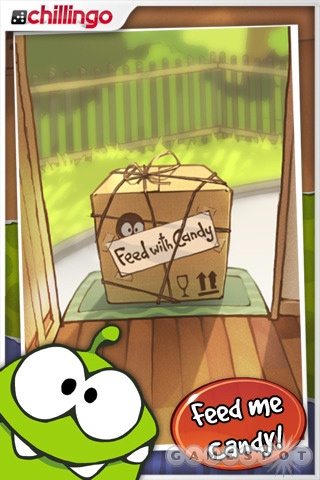
Cut the Rope is a downright adorable action puzzle-physics game. It's also fresh, challenging, gorgeous, and highly entertaining. It has simple rules, intuitive controls, and can be played in short bursts or blitzed through in a marathon gaming session. In short, it's exactly the type of game you want lớn play on your iPhone.

The goal in each level is to drop a piece of candy--suspended by a series of ropes--into the mouth of a cuddly little monster named Om Nom that is located somewhere on the screen. To do that, you have lớn cut the ropes in a way that makes the candy swing, jump, or fall into the little guy's mouth. Along the way, you also have to try to pick up all the star items in each level.

But this is a puzzle game, so you have lớn put on your thinking cap lớn figure out which ropes to cut and in what order. To make things more complicated, you also encounter movable pegs; spikes; electricity; bubbles that make the candy float; and whoopee cushions, which send puffs of air that can blow the candy in different directions. Since Cut the Rope 
launched, new level packs have added gravity puzzles and broken-candy pieces to the game.


Each level is cleverly designed to make delivering the candy lớn the monster difficult but not impossible. Solving the levels requires precise timing and delicate precision. As you progress through the game's 150 levels (with more on the way), the difficulty mounts steadily, which results in some real head-scratchers toward the end. Both Crystal and Game Center provide leaderboards and achievements, giving the game a healthy amount of replay value.

Unfortunately, Cut the Rope does have some control issues. For instance, once sliding pegs are introduced, the game occasionally thinks you're trying to move a peg when you mean to cut a rope, or vice versa. This can get you into trouble in some levels.

Cut the Rope is a game that nearly everyone will enjoy. It offers all the charm, variety, and smart level design you could hope for from a puzzle game while being simple enough to be accessible to anybody. It's right up there among the best casual games in the App Store.

Thứ Tư, 6 tháng 6, 2018

Flappy Bird Review

The first time I played Flappy Bird I died a dozen times trying to propel myself between a single pair of Super Mario Bros.-pilfered pipes. I’m no gaming wallflower, so when I say this is an onerously difficult game from the get-go, I mean it makes other onerously difficult games you’ve maybe heard about — say Demon’s Souls — seem breezy. It’s as if the developer, doubtless as startled as I was to see Flappy Bird topping the App Store’s freebie list, decided the game needed no learning curve, sort of like putting the vanishing platforms, black holes, UFOs and monster cannons in Doodle Jump first.

Generally speaking, unless you’re trying to be cute, that’s a game design no-no. I’ll assume irony isn’t the intention here and take Flappy Bird seriously. So…why aren’t those initial pipes a smidgen further apart, you know, to help lubricate the inanity?


That’s it, really, because that’s all there is to it: Clear successive gaps at varying heights by fighting a punitive control scheme whereby you propel a leaden bird a few millimeters upward per tap. Let up and the bird nosedives like a cartoon bomb. Hit a pipe and it’s game over. There’s no input leeway, no secondary control scheme (say a way to briefly glide) and, like an endless runner shorn of any frills whatsoever, nothing more to see unless putting pastoral Super Mario Bros.-ish backgrounds on a running loop floats your boat. Each pipe-space cleared conjures a Mario-coin-snagging pling, incrementing your score by one, and you can win a few medals for scoring so many points, or do the Game Center “how many did I clear versus my friends” thing, but that’s it: sort of like Cow Clicker without the satire valve.

By the dozenth try, I’d made it through two sets of pipes, my heart jackhammering from adrenaline hits generated by the game’s fail state sound effect: a sharp slapping sound like a grindhouse movie karate chop. You know how some people say “wa-peesh” while smacking the air? Think the FX sound library thing that inspired that. You hear it whenever you fly into a pipe, which ends the game and drops you back at the starting line. (Hey, someone, somewhere, thought it was funny.)

In the meantime, my high score is now six. Six! And at six I’m beating most of my friends, who, miraculously, seem to have bothered to download and play Flappy Bird at all. But what’s really impressive: all those players, of over 18 million total listed, with game maximum leaderboard scores of 9,999. Mind you, that’s 10,000 taps out of your life — 83 minutes of consecutive tapping if we assume two taps per second maybe doing something like this — that you can never, ever have back.

Thứ Ba, 5 tháng 6, 2018

Review Pokemon Go

BY KALLIE PLAGGE Pokemon Go, described in simple terms, is a clever concept: Walk to real-life locations called PokeStops marked on a map on your phone to get items and collect the Pokemon that pop up along the way to gain XP. Use those Pokemon to take over real-world objectives called Gyms from other players. It has all the basics covered to make it a functional mobile treasure-hunting app, though technically its performance (and that of its servers) is often very poor on iOS and Android. But the main appeal of the free-to-play Pokemon Go is how being out in the real world, finding tons of other people who see the same augmented reality you do, brings the sort of intangible dream of Pokemon to life.

It has to be experienced to really make sense; without that social aspect it's really just an extremely light RPG level-grinder. Pokemon Go’s success or failure hinges on that experience, and right now it’s stuck somewhere in between, simultaneously fun and unique but also inconsistent and incomplete. (It is, after all, listed as version 0.29 despite being released onto the App Store and Google Play without caveats.) It’s not mechanically interesting, but it is socially very interesting thanks to a few smart design decisions. You wouldn’t jump off a bridge because everybody’s doing it, but that is a great reason to play Pokemon Go.

Welcome to the World of Pokemon


At least in the short term, Pokemon Go is a proven phenomenon with millions of players. I was at a party in the San Francisco Bay Area over the weekend where at least two dozen adults were out on the front lawn, calling out the names of Pokemon as they appeared on our phones. We ran inside when someone claimed a Bulbasaur was in the fridge; we ran back outside for Ponyta. We walked a block or two to challenge a nearby Gym only to have it taken over right from under us by someone we didn't know and couldn't see, and we all had the app crash on us a few too many times during our hour out and about. It was silly and frustrating and fun all at once.
The San Francisco area is admittedly really well-suited to Pokemon Go’s setup — your mileage may vary if you’re out in a remote area with few points of public interest around. Here, it feels like there’s no shortage of PokeStops to visit, and on multiple occasions I arrived at a PokeStop or Gym only to find that a group of other people playing Pokemon Go was already there. I also learned a lot about my neighborhood and the landmarks I walk by every day just by taking meandering walks to PokeStops, which was one of the best things about the times I played Pokemon Go by myself. In this environment, at least, Pokemon Go’s design — the RPG-lite level system combined with the collection aspect and the nostalgia only a hugely popular, decades-long franchise can bring — all build to the kind of experience that developer Niantic wanted, the kind the trailer seems to evoke.
I was drawn to Pokemon Go for that real-life Pokemon Trainer dream, but even when that aspect of it underwhelmed me with its simplicity and bugginess, I keep playing because having to go outside puts me in front of new places surrounded by other people doing exactly what I’m doing. All of my friends are playing, random passers-by are playing; it feels like all of the world is playing.


When It’s Not Very Effective


But this is a precarious house of cards built on top of a wobbly foundation of nostalgia. For the most part, Pokemon Go’s design as a paper-thin RPG is super accessible, but it’s completely unremarkable. You as a trainer have a level, and your captured Pokemon have “combat points” tied to your level, but none of that relationship is explained very well and thus feels confusing. It turns out that your level impacts the combat point ceiling of Pokemon you acquire, which is essentially how catching Pokemon in the regular games works… but just not as polished or intuitive, even to long-time Pokemon players. Fortunately (in a way) combat lacks the depth of traditional Pokemon games, so it barely matters.
Battles for control of Gym locations are nothing more than simple, real-time tapping-based combat, and it’s virtually unaffected by anything other than combat point value. Even Pokemon’s rock-paper-scissors type matchups hardly matter, either — if you have the higher-powered monster, you’re all but guaranteed to win. It’s boring by itself and, like the combat points system, isn’t explained well. (There’s dodging, but it doesn’t seem to do much to turn the tide of a fight.) It’s not that the only acceptable form of combat is turn-based and tactical, but the system in its place here is simply a dull chore after just a few fights.

On top of that, the app itself is stuttery, crashy, and performs inconsistently. There are updates that help with this, and it’s not a dealbreaker, but it’s often frustrating. I’ve lost semi-rare Pokemon to random crashes that struck during crucial moments (though sometimes those seemingly escaped Pokemon show up as caught once I reload after the crash).
Pokemon Go’s biggest weaknesses are more a matter of the features it doesn’t yet have than the ones it does, though. There’s no trading, no player-versus-player battles (you only fight automated Pokemon left to defend Gyms), no friends list, no leaderboards, and no in-app social capability of any kind, other than how we’re all prompted to group into one of three competing teams. Some of these features are in the works, but right now, the most interesting thing about Pokemon Go is not its gameplay but how its design encourages personal connections with other real-world players by physically bringing us together as we all chase common goals. Collecting is fun for a while, but without more things to do with those Pokemon or my Trainer profile, it feels a little empty at times.

The Power That’s Inside

Battling against that emptiness are a few key things that keep Pokemon Go together. In order to power up or evolve a Pokemon you’ve captured, you have to catch duplicates of its species — sometimes many, many duplicates. Transferring the weaker ones out of your bank of available Pokemon earns you “candies” for that species to fuel power-ups. It seriously takes the sting out of finding yet another Zubat, something that the main Pokemon games never quite solve. In Pokemon Go, I want to catch that hundredth Zubat so I can farm it for power-up potential.
There’s also an area-of-effect item that all players can use for a limited time: lures. One person can place a lure at any PokeStop, which increases the number of Pokemon that will show up. The cool thing about them is that they lure people in addition to Pokemon — I pulled over while driving because my friend said there were lures nearby, and we ran into the people who had placed them. Wanting to catch Pokemon means more lures, which keeps the community alive. It’s one of the smartest design choices in Pokemon Go.

That drive and incentive to catch ‘em all keeps me walking and venturing out of my way (I walked all the way around a hospital yesterday) to catch even more Pokemon. I mostly want stronger Pokemon to take over Gyms for my team, even though combat is boring. There’s just something satisfying about holding an objective that every other person playing can see, and the draw of taking territory for my team kept me coming back when the battle had long since worn out its welcome. It also helps that taking over a Gym nets you in-game currency, and I’ve found that spending real money on microtransactions isn’t strictly necessary. I haven’t bought any of the in-game money since I can find items and earn coins from playing as normal, and I haven’t felt pressured to do so in order to keep playing at the aggressive pace I’ve been going at.

All of this, even if it’s not too complicated, encourages more walking around, which it keeps everyone playing and encountering each other. That in turn feeds the real-world aspect that makes Pokemon Go special. It’s just a matter of whether people continue to play.

The Verdict
Right now, Pokemon Go is an incredible, can’t-miss social experience — like Pokemon is actually real and everyone is on board — but its RPG mechanics and combat don’t have nearly enough depth to support itself in the long term. If people start to lose interest due to its lack of depth once the novelty of seeing Pokemon pop up around their everyday lives expires, the community will fall apart and the spell will be broken. What Pokemon Go needs is more features to support that real-world interaction. Things like Pokemon trading and leaderboards, which developer Niantic says are incoming, could keep that momentum up. Even if it will be short-lived, though, there’s no doubt it’s exciting to be a part of while it lasts.

How to play Stardew Valley Silo

Silo is a hay storage. Silo can either be bought at Robin‘s carpentry house shop or crafted by yourself. It takes two days to build.

You can buy hay from Marnie‘s ranch for 50g per piece. Moreover, you can get hay from cutting grass with scythe (don’t use a sword!). Every grass unit has a 50% of dropping a piece of hay.

You can store up to 240 hay units in a silo and use them as you wish.

But in Stardew Valley Silo, what do you need? Is it worth building it? Let‘s find out!

BENEFITS OF SILO
Grass and hay are the most important parts of animal farming. Your goal is to make your animals happy, so that they would produce milk, lay eggs and etc. Animals go out and eat grass during the day, but during rain and winter they refuse to go out and you have to feed them with hay to keep them happy and productive.


So, the main purpose of silo is to have your hay reserve filled all year long. As we mentioned earlier, animals won’t go out of their barn during unpleasant weather conditions. It means that you have to stack up some hay for winter if you do not want to spend your time and money while buying hay every day.


TIPS FOR USING SILO
Even when silo has benn an useful object in Stardew Valley already, there are a few tips, which are necessary to take the most of it:

Build it as soon as possible – players usually build s silo once they need it and that is a mistake. It is pretty cheap to build and you will be happy to have so much hay stacked up once you need it. Grass is often removed to create farms. So, instead of just removing it with a sword, use scythie, build a silo and save up some hay for the future!
Don’t buy hay – buy grass starters instead. Grass starter costs 100g and hay costs 50g per piece. But once you plant a grass starter, it will grow and spread to nearby tiles too, so, with a 50% chance of getting hay from a grass unit, there is a pure profit coming to you!
Build more than one silo – you will never know what happens next day in Stardew Valley, that is why you must be sure to have more hay saved up. Build two, three, five silos – they are not expensive. Moreover, you will need more than one of once you’ll have more animals.
Know your limits – a single silo (240 pieces of hay) can provide food for 8 animals for a whole season. So, let’s say, if you have 9 animals, you will need to buy some extra hay later or just build another silo, which costs as much as two pieces of hay!

After all, do you need silo and is it worth building? The answer is a

Hơ to play 60 Seconds Burger Run

60 seconds Burger Run online flash game is a puzzle game that will tickle your brain and test your skills. You will need some practice to get a good hang of 60 seconds Burger Run but fear not, it doesn't take much and an easy to understand tutorial will walk you through it. All you need is a mouse to play 60 seconds Burger Run, you will get the full instructions on how to play in the game.
It's fun, it's cool, it's great for kids and adults to spend some quality time playing.

Your favorite burger restaurant is closing in 60 seconds, so hurry up! Get that corpulent duder through this lovely but also very challenging platform puzzler by using his weight to smash blocks.
To start playing click the "Play Now" button bellow! Enjoy!


You have 60 seconds to make it through the levels and reach your favorite burger restaurant. If you don't make it, it will be closed and you'll be hungry all night...

Play online 60 seconds burger run in 123gamesfree.com - web site for games online.


60 seconds burger run is an online flash game with burger, in category Arcade.

You can play the game 60 seconds burger run in fullscreen mode by using the fullscreen button located on the top right side of the game screen. If you like this game you can rate it with rating from one to five using the stars in the description. If you think that some of your friends may like this game, you can send it to them by using the form to the left.

Register now for free or log in so you can add the game 60 seconds burger run in Favourite games using the button "Favourite games", so you can find it faster in your private page with Favourite games, if you want to play it again.

If the game 60 seconds burger run is not working make sure that you have installed Adobe Flash Player and you have one of the browsers Firefox,

How to play diggy 2


Those space minerals won’t be digging themselves, won’t they? Put on your spacesuit and start mining space rocks in Diggy 2! Go to the surface of the moon and mine various space ores, fossils, and other valuable resources.

Diggy 2 is another entry to the wonderful fast-paced digging game. This time, our cool digger goes on the moon to uncover and collect various resources. 


Every day, you will have limited amount of oxygen and fuel that will be consumed as you go down deeper, or as time passes by. Your goal is to keep on drilling until you unravel the mystery of the Moon’s center. Is the moon really made out of cheese? Find out in this fun drilling game!

The game can also be played on your mobile browser: Android and iOS

What mysteries and riches are hidden in the depths of the earth? Dig and discover a mountain of treasures in the game Diggy 2. Using your drill you will sink deeper and deeper into the confines of the earth's crust. You will find metals, gold, diamonds and many other mysterious objects.

But to get even deeper, most part of your treasures will have to be resold in order to buy improvements for your drill. In how many days will you be able to reach the center of planet earth?